
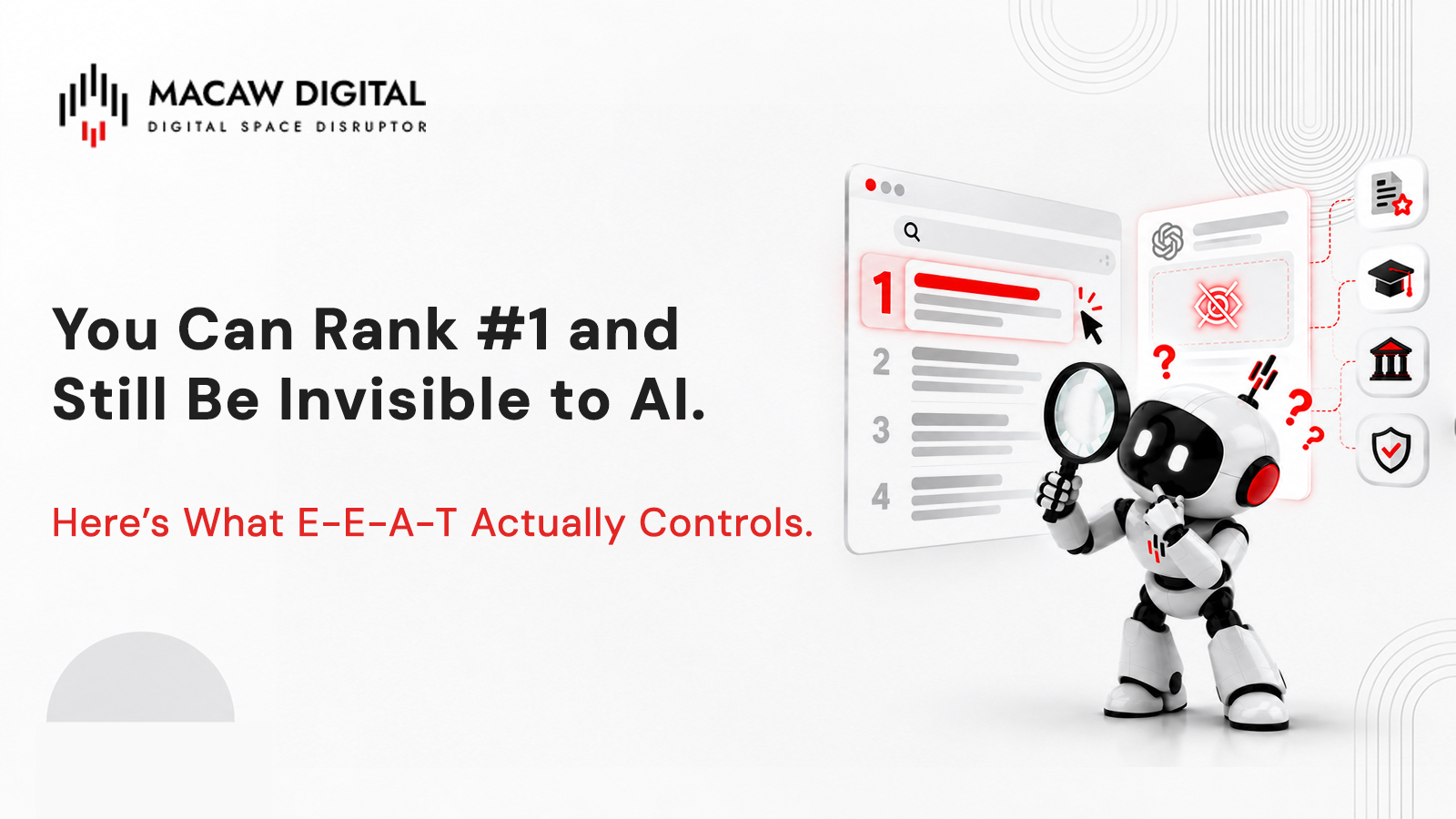
For twenty years, ranking #1 on Google meant one thing: you were the answer. That’s broken down. A page can hold the top organic spot and never appear in the AI Overview sitting above it, never get cited by ChatGPT on the exact question it answers, never get mentioned in Claude, Perplexity or Gemini summary. Being first no longer guarantees being seen.
The framework increasingly deciding who gets cited by AI and who gets skipped is one Google has discussed for over a decade, mostly as a background signal: E-E-A-T, short for Experience, Expertise, Authoritativeness, and Trustworthiness.
To be precise about the claim here: E-E-A-T isn’t a switch you flip to get cited, and traditional SEO hasn’t become irrelevant. What’s changed is narrower. The same trust signals Google has scored for a decade now also work, in real time, as the shortcut retrieval systems use to decide which handful of sources to lean on. What follows covers what E-E-A-T actually is, why it now functions less like a ranking nudge and more like an eligibility filter for AI citation, and what to do about it. Official guidance is kept separate from industry speculation throughout, and speculative figures are flagged as directional rather than presented as settled facts.
Before You Optimize Anything: Does This Even Apply to Your Queries?
This is the part most E-E-A-T coverage skips, and it should shape your priorities before any pillar-by-pillar advice does.
Not every query gets an AI-generated answer at all, and not every AI answer carries a citation. OpenAI’s own documentation is direct about this: citations only appear when ChatGPT actively browses the web, either because it judged the question needed current information or the user manually triggered search. An answer pulled from frozen training data carries no citation, because there’s no live source to point to. If a meaningful share of your target queries get answered from a model’s memory rather than a live search, no amount of E-E-A-T work on your page changes that outcome. There’s no retrieval happening for it to influence.
The same floor applies on Google’s side. A page must already be indexed and eligible for regular Search, meeting technical requirements, before AI Overviews or AI Mode will even consider it. If your indexing or technical SEO has gaps, that’s the actual bottleneck, and it sits upstream of everything about experience, expertise, or authority.
So before building an E-E-A-T program, get an honest read on two things: how many of your priority queries currently trigger an AI Overview or a browsing-enabled AI answer at all, and whether your own pages are cleanly indexed and technically eligible in the first place. That question decides more than any pillar-optimization tactic will.
What E-E-A-T Actually Is
E-E-A-T comes from Google’s Search Quality Rater Guidelines, an internal document given to thousands of human contractors who manually evaluate search result quality. Google introduced the original three-letter version, E-A-T, in 2014. In December 2022 it added the second E, for Experience, formally recognizing that someone who has actually used a product or lived through a situation brings something a purely researched article can’t replicate.
Here’s the most misunderstood point about E-E-A-T, and Google states it plainly: it is not a ranking factor. Per Google’s Search Central guidance, quality raters give Google insight into whether its algorithms are producing good results, a way to confirm changes are working as intended, but rater data is not used directly in the ranking algorithms. Google’s own analogy: raters are like diners filling out feedback cards. The feedback tells the kitchen whether a dish is landing, but the diners don’t cook the food. In practice, E-E-A-T is a lens Google’s evaluators use to score pages, and those scores feed back into how ranking systems get tuned over time, rather than being checked against your page the moment someone searches.
E-E-A-T carries the most weight for what Google calls YMYL content, short for “Your Money or Your Life”: topics affecting health, financial stability, safety, or wellbeing, where mistakes carry real consequences. Reporting on Google’s most recent rater guideline update, released September 2025, indicates YMYL was expanded around government and civics topics, and that the same update introduced the first concrete evaluation criteria for AI-generated summaries in search results.
The four pillars break down like this:
Pillar | What It Means | How It’s Typically Demonstrated |
Experience | First-hand, lived involvement with the topic | Original photos, documented testing, personal narrative, “I did this” framing |
Expertise | Depth of knowledge in the subject | Named author, credentials, technical accuracy, demonstrated skill |
Authoritativeness | Recognition by others as a go-to source | Backlinks, citations from other reputable sites, being quoted elsewhere |
Trustworthiness | Accuracy, transparency, and safety | HTTPS, clear sourcing, honest claims, correction policies, verifiable identity |
Google’s guidelines treat trust as the load-bearing pillar. A page can show genuine experience and real expertise and still score poorly overall if it isn’t trustworthy, since a lack of trust undermines everything else on the page.
Why AI Search Changes How E-E-A-T Functions
Historically, E-E-A-T’s effect on any single page was indirect and slow: build trust signals, and over time rater feedback might shape how you rank. For AI-generated answers, the mechanism appears more immediate, and that comes down to how these systems are actually built.
Google’s official guide to optimizing for generative AI search, last updated mid-2026, explains the mechanics. AI Overviews and AI Mode run on retrieval-augmented generation, which Google also calls “grounding.” They rely on Google’s core Search ranking systems to retrieve relevant, up-to-date pages from the regular index, review specific information from those pages, and generate a response with clickable supporting links.
A second mechanic: query fan-out. A single question often triggers several related queries behind the scenes before the final answer is written. Google’s example: “how to fix a lawn that’s full of weeds” might silently fan out into “best herbicides for lawns” or “remove weeds without chemicals.” That means multiple entry points can earn a citation on one topic, not just one.
A recent example of this pattern in practice: Google’s March 2026 broad core update, confirmed complete on April 8, 2026 via its Search Status Dashboard, is a useful test case. Google’s own description of the rollout was minimal: it called the update “a regular update” and published no companion blog post naming E-E-A-T or Experience as specific targets. Industry trackers observed real ranking volatility during the rollout and widely attributed it to stronger enforcement of experience and authorship signals, but that attribution is analyst inference from outcomes, not a claim Google made. It’s a live illustration of the gap this article keeps flagging: real, dated events get reported with more certainty about why they happened than the primary source actually confirms.
OpenAI’s Help Center confirms the parallel mechanics on its side. ChatGPT can search the web, and responses using search may include citations, selectable to open the source, with a “Sources” panel for cited and related links. OpenAI is candid that search results and citations can be incomplete, outdated, or incorrect, and encourages verifying a cited source before relying on it. For heavier requests, OpenAI describes deep research as agentic: rather than returning a list of links, it plans and carries out a multi-step process of searching, evaluating sources, refining its own queries, and synthesizing findings, with every output designed to carry checkable citations.
Why does trust matter more once AI enters the picture? Here’s the mechanical reason, though neither company states it as policy: a generative answer doesn’t have unlimited room to hedge. It typically synthesizes from a small handful of sources rather than the eight-plus blue links a normal results page shows, so competition for each citation slot is sharper. That would explain why these systems lean harder on identifiable, checkable trust signals as a shortcut: a named author with real credentials, a page that cites its own sources with dates, a domain with an established track record. Those are signals a retrieval pipeline can verify quickly and cheaply.
Do the Math Before You Trust the Citation-Accuracy Stat
A study in Nature Communications found a substantial share of LLM-generated citations don’t fully support the claims attached to them, with failure-rate estimates ranging from roughly half to the large majority, depending on model and task.
Sit with that range before you plan around it. “Somewhere between half and the large majority” spans a moderate quality problem and a near-systemic one, and those call for very different responses. A gap that wide usually means the underlying studies differed enough in model, task, and definition of “supports the claim” that they aren’t really measuring the same thing. Treat the finding as directional evidence that citation accuracy is a real, non-trivial issue, not as a number to build a business case on.
The same caution applies to the ranking-versus-citation overlap figures below, and to the tactic-lift table further down. They’re useful for spotting a pattern, not for forecasting your specific page’s odds. A wide range across sources is itself a signal that no one actually has a precise number yet.
What Independent Research Suggests About Citation Patterns
Neither Google nor OpenAI publishes precise citation-rate statistics, so treat what follows as directional, not a benchmark.
Ranking and citation are correlated but not identical. A widely circulated 2026 analysis found only a minority of pages cited in AI Overviews also rank in Google’s top 10, and that the old tight correlation between domain authority and AI citation has weakened considerably. Part of the explanation is that passage-level relevance can beat page-level rank: a page at position 3, or even 7, can still get quoted if it contains the clearest, most self-contained passage answering the question.
Different platforms weigh signals differently, too. ChatGPT is reported to lean on third-party intermediary sites (reviews, roundups, forums) over brands’ own domains; Perplexity reportedly leans more on traditional domain authority; Google’s AI Overviews track more closely with overall SERP visibility. There’s no single playbook that transfers identically across systems.
Two related patterns recur across studies. First, third-party validation dominates branded queries: one large-scale analysis of tens of thousands of citations found that for purchase-decision queries, reviews, listicles, forums, and case studies capture most citations, with brand marketing copy trailing well behind, suggesting AI systems reach for social proof over self-description. Second, brands get cited more through other people’s pages than their own: mentions on Wikipedia, YouTube, Reddit, and industry roundups reportedly generate meaningfully more citations than a brand’s own domain. A handful of large, trusted publishers may function as informal gatekeepers. If a brand doesn’t appear on sites a model already trusts, it may simply not surface in that model’s answers.
A note on numbers you’ll see elsewhere: search around this topic and you’ll run into a lot of suspiciously precise, uncited stats (“96% of citations,” “2.3x more likely,” correlation coefficients quoted to two decimal places). Several of these figures show up verbatim across unrelated sites with no traceable original study, which is a strong sign they’re being copied rather than sourced. Treat any number in this space that isn’t tied to a named study you can go check as marketing copy, not data.
What Google Tells You Not to Bother With
This is arguably the most useful part of Google’s own guide, since it corrects a lot of “GEO” folklore. You don’t need an llms.txt file: Google says outright it doesn’t use these, and creating one neither helps nor hurts. You don’t need to “chunk” content into small pieces; Google’s systems already understand nuance across a page. You don’t need to rewrite content specifically for AI, since Google’s systems already understand synonyms and general meaning. Chasing inauthentic “mentions” isn’t effective either; core ranking systems focus on genuinely high-quality content while separate systems catch manipulative link-building, and AI features depend on both working together. And structured data isn’t required for AI visibility, though Google still recommends it for regular rich results.
Google’s actual recommendation is simpler: keep applying foundational SEO (clear technical structure, genuinely useful and non-commodity content, good page experience), because its AI features are rooted in the same core ranking and quality systems as regular search.
Building Each Pillar in Practice
For experience: publish original photos or footage of actual use, not stock imagery, and document a process over time rather than summarizing what other sites already say. Google’s own guidance distinguishes a first-hand review from a summary, which it says merely restates existing information with little unique value.
For expertise: byline content under a real, identifiable person, not “Admin” or “Editorial Team.” Give the author a bio with checkable credentials, kept consistent across everything they publish.
For authoritativeness: this work happens outside your own site, through earning mentions in independent publications, contributing to roundups, and showing up in relevant forums. A mention on a site an AI system already trusts appears to do more than another post on your own domain.
For trustworthiness: cite your own sources, attribute statistics to a named, datable origin, and correct errors visibly rather than quietly. Basic hygiene (HTTPS, a real contact page, transparent authorship) still functions as a baseline signal.
A few structural habits help retrieval systems pull content cleanly: answer the core question within the first few sentences of a section, use headings that match how people actually phrase questions, build comparison tables and numbered steps rather than dense prose, and keep an accurate “last updated” date, since freshness is itself a retrieval signal.
One industry analysis reported visibility lifts from specific tactics, summarized directionally below. Read these as “roughly this order of magnitude, from one uncited source,” not as figures to plan a campaign around:
Tactic | Reported Direction and Rough Size |
Citing authoritative sources within your own content | Large positive lift (reported in the 30 to 40%+ range) |
Adding specific, attributed statistics | Large positive lift (reported in the 30 to 40%+ range) |
Including expert quotations | Moderate-to-large positive lift (reported around 25 to 30%) |
Writing in an authoritative, direct tone | Moderate positive lift (reported around 20 to 25%) |
Improving overall clarity | Moderate positive lift (reported around 15 to 20%) |
Keyword stuffing | Negative. Actively hurts, though the reported size is small |
Who Should Prioritize This Now, and Who Can Wait
Prioritize E-E-A-T work now if most of these hold: your content already ranks reasonably well but rarely gets cited in AI answers; your topic is YMYL (health, finance, safety, civics); your competitive set is full of anonymous or thin-bylined content, leaving room to stand out; you have resources to name real authors and gather original data or firsthand testing; and your indexing and technical SEO are already solid, so the floor is met and the ceiling is what’s left to raise.
Wait, or fix something else first, if: your pages aren’t reliably indexed or meet basic technical requirements yet (that’s the actual blocker); your target queries rarely trigger AI Overviews or browsing-enabled answers in the first place; you have no ability to attach real, checkable names and credentials to content; or you’re chasing this because “AI search” is the current conversation rather than because you’ve confirmed a citation gap exists for your own terms.
Where Things Go Wrong
Common mistakes recur: treating GEO as a copy-paste of old SEO, since keyword density and raw backlink volume don’t transfer cleanly to AI citation; anonymous or generic bylines that give retrieval systems nothing to verify; unattributed statistics that AI systems are more likely to discount or skip; betting everything on your own domain instead of also earning third-party presence; assuming one platform’s visibility generalizes to all of them, when Google, ChatGPT, and Perplexity weigh signals differently enough that each may need its own approach; and chasing AI-specific hacks Google has already said don’t matter, like llms.txt files or artificially chunked content.
A 90-Day E-E-A-T Audit Worth Running
Structure it around evidence, not assumptions.
Before you touch content
- Confirm your priority pages are indexed and technically eligible for regular Search. This is the actual floor, and skipping this check wastes everything that follows.
- Manually check, for your 10 to 15 highest-value queries, whether AI Overviews or browsing-enabled AI answers even appear. If they don’t, deprioritize those queries for this project.
- Baseline your current citation status: search those queries in ChatGPT (with search on), Perplexity, and Google, and note whether and how your domain appears.
Build
- Pick 3 to 5 pages where you already rank but don’t get cited. Attach a real, named author with a checkable bio.
- Add original data, a documented first-hand test, or a dated expert quote to each. Not a rewritten summary of what competitors already say.
- Identify 2 to 3 third-party sites (industry roundups, forums, trusted publishers) where you can earn a genuine mention, not a paid placement.
Run and decide
- Re-check the same queries at 90 days across the same three platforms.
- Judge by citation appearance and passage-level pickup, not traffic alone. Citation and click-through are separate outcomes.
- If nothing moved, the likely culprits are the query-coverage problem above (no AI answer being generated for that query at all) or a trust gap deeper than what one round of edits fixed. Diagnose before repeating the cycle.
The Bigger Opportunity Is Being Part of the Answer
Paid placement and AI citation both point to the same shift: people increasingly bring AI systems the questions they used to break into several searches. That makes durable trust signals (a named expert, a firsthand account, a mention on a site the model already trusts) worth more than another round of keyword-matched content. Ranking #1 is still the price of entry. It just isn’t the whole game anymore.
The Bottom Line
E-E-A-T itself hasn’t changed. Google’s four pillars, and its insistence that they’re an evaluation framework rather than a ranking signal, have stayed consistent since 2022. What’s changed is how directly those values now function as a practical filter in retrieval pipelines that must quickly decide, out of many possible sources, which handful to cite in a single answer.
But indexed eligibility is a floor, not a ceiling, and a large share of queries never trigger an AI citation at all. So the first question isn’t “how do we win E-E-A-T,” it’s “does this even apply to the queries we care about.” For the queries where it does, the sites gaining AI visibility tend to be the ones building genuinely verifiable trust: named experts, first-hand experience, recognition from independent sources, and content structured to be cleanly lifted out of context. Not the ones purely defending a blue-link position that increasingly sits beside, or beneath, an answer many users never scroll past.
Where to Go From Here
If you’ve read this far, you likely already suspect which of the three problems is yours: no AI citation because the query never triggers an AI answer, no citation because of a technical or indexing gap, or no citation despite a real opportunity because a specific E-E-A-T pillar is weak. Those are diagnosable, in that order, without guesswork: check query-trigger rates first, indexing second, and only then start auditing authorship, sourcing, and third-party presence pillar by pillar.
If you’d rather have that diagnosis run for you, Macaw Digital offers AI-citation audits that check priority pages against Google, ChatGPT, and Perplexity, and hand back which pillar is actually costing visibility rather than a generic checklist. That’s one option among several. The audit above is also something an in-house SEO or content lead can run directly using the steps in this piece.
Frequently Asked Questions
Is E-E-A-T a direct Google ranking factor?
No. It’s a framework human raters use to evaluate search quality; rater data feeds into how ranking systems are tuned over time rather than being applied directly at the moment of a search.
Does ranking #1 guarantee AI citation?
No. Independent analyses find a fairly low overlap between top-10 rankings and AI Overview citations. Passage-level relevance and trust signals appear to matter more than overall page rank.
Does E-E-A-T even apply if my queries never trigger an AI answer?
Not directly. Citations only appear when a system actively browses the web for that query; answers pulled from frozen training data carry none. Check whether your priority queries trigger AI Overviews or browsing-enabled answers before investing heavily.
Do I need an llms.txt file?
Not for Google Search; Google says it doesn’t use these files. It may still matter for other AI systems that do reference them, so check each platform’s own documentation.
Which matters more, my own domain’s authority or third-party mentions?
Both, but don’t neglect the second. Independent analyses suggest brands earn significantly more AI citations through third-party pages than through their own domain content alone.
Do I need structured data to be cited by AI?
Google says it isn’t required for generative AI search specifically, though it’s still worth using for regular rich results.
How does ChatGPT decide what to cite, versus Google?
Both rely on real-time web retrieval rather than pure training data. Google calls this retrieval-augmented generation, or “grounding”; OpenAI confirms citations only appear when ChatGPT actively searches the web. Independent research suggests the two platforms may weight source types somewhat differently, with ChatGPT reportedly leaning more on third-party intermediary content.
Sources
Primary sources, from Google and OpenAI’s own documentation:
- Google Search Central Blog, “Our latest update to the quality rater guidelines: E-A-T gets an extra E for Experience” (December 2022)
- Google Search Central, “Creating Helpful, Reliable, People-First Content”
- Google Search Central, “Optimizing your website for generative AI features on Google Search” (updated July 2026)
- Google, Search Quality Rater Guidelines (public PDF)
- Google Search Status Dashboard, March 2026 broad core update rollout record (March 27–April 8, 2026)
- OpenAI Help Center, “Searching the web with ChatGPT”
- OpenAI Help Center, “ChatGPT search for Enterprise and Edu”
- OpenAI Academy, “Research with ChatGPT”