
Search is changing, but the biggest change isn’t another Google algorithm update. It’s where users look for answers.
Instead of typing keywords into Google and comparing results, users ask ChatGPT, Google AI Mode, Gemini, or other AI platforms a complete question and get a direct answer: which digital marketing agency is best for B2B, which software suits warehouse operations, which product fits a specific need.
If competitors consistently appear in those answers while your brand doesn’t, you may be missing users before they reach your website. That’s the practical meaning of AI search visibility: how often your brand appears in AI-generated answers for questions that matter to your business.
The shift is measurable. Semrush’s 2026 AI Visibility Index analysed more than 126 million real U.S. AI search prompts across ChatGPT, Google AI Mode, Google AI Overviews, and Gemini. Separately, GEO research firm Brandlight found that overlap between top-ranking Google links and AI-cited sources has fallen sharply in two years. Ranking well in traditional search no longer reliably predicts AI visibility.
What Is AI Search Visibility?
AI search visibility is how much your brand appears when AI platforms answer questions related to your business, products, or industry.
There’s an important difference between being mentioned and being cited.
A mention means your brand appears in the answer. A citation means a page was used as a source. These don’t always happen together.
Semrush’s 2026 study found 61.7% of AI citations were “ghost citations”: the site was cited, but the brand itself was never named.
A citation alone doesn’t mean you influenced the decision. If your site is cited while a competitor gets recommended, you earned a source credit without necessarily earning the business opportunity.
So the better question isn’t “Are we being cited?”
It’s:
How AI Platforms Actually Decide What to Cite
Google’s AI search experiences don’t necessarily treat a user’s question as a single search. They can use a process known as query fan-out, where a complex question is broken into multiple related searches.
For example, “What is the best warehouse management software for manufacturers?” could require information about warehouse management systems, manufacturing use cases, software features, pricing, integrations, and implementation.
The final answer can then be assembled from information discovered across these related searches.
This means a brand can rank well for one primary keyword and still be absent from an AI answer if its content does not address the broader questions surrounding the topic.
Three factors are particularly important when creating content that can be understood and used by search systems:
Structural clarity: Can the important information be understood quickly? Use clear headings, direct answers, descriptive sections, and concise paragraphs.
Source credibility: Does the page appear authoritative, and is the information consistent with how the business is described elsewhere?
Freshness: For topics where information changes frequently, keep important pages updated when facts, products, pricing, regulations, or recommendations change.
The practical lesson is simple: don’t optimise a page for one keyword alone. Build useful coverage around the questions users ask before, during, and after that query.
Why Traditional SEO Isn’t Enough
Strong technical SEO, useful content, internal linking, and good rankings remain the foundation.
Google’s guidance says traditional Search fundamentals also apply to AI Overviews and AI Mode. That includes helpful, people-first content, crawlable pages, good page experience, strong internal linking, and structured data that accurately reflects visible content.
But ranking well doesn’t guarantee that your page will appear in an AI answer.
AI search optimization builds on SEO. It doesn’t replace it.
The difference is what you’re measuring.
Traditional SEO asks: “Where does my page rank?”
AI search visibility asks: “Does my brand appear when users ask relevant questions?”
A stronger AI visibility analysis asks:
“Is my brand accurately described, cited, mentioned, and recommended for commercially important questions?”
How to Audit Your AI Search Visibility
Don’t start by rewriting your entire website. Start with the questions users actually ask.
Build a list covering the decision process:
- Informational: “What is [service]?”
- Research: “What are the best options for [need]?”
- Comparison: “[Option A] vs [Option B]”
- Pricing: “How much does [service/product] cost?”
- Decision-stage: “Which company provides [specific service]?”
Test them across the AI platforms relevant to your audience.
For each question, record:
- Does your brand appear?
- Which competitors appear?
- Which sources are cited?
- Which pages are cited?
- How is your business described?
- Is the description accurate?
- Which questions are you missing?
Test variations too. You may appear for “best digital marketing agency in India” but disappear for “best B2B SEO agency in India.
Group related questions by topic rather than treating every prompt as a separate keyword. This gives you a more realistic picture of your visibility.Group related questions by topic rather than treating every prompt as a separate keyword. This gives you a more realistic picture of your visibility.
How to Improve AI Search Visibility
Use a simple loop:
Question → Gap → Reason → Action → Recheck
| What you find | What it could mean | What to do |
| Competitor appears, you don’t | Content or topic gap | Create or improve content addressing the question |
| You appear but aren’t cited | Weak supporting source | Strengthen first-party content and credible external references |
| You’re cited but not mentioned | Content is useful, but brand visibility is weak | Improve brand positioning and business information |
| AI describes you incorrectly | Information is outdated or inconsistent | Correct important details across your website and external sources |
| One competitor dominates | Stronger topic coverage or authority | Build deeper, more useful coverage |
For example, if competitors appear for “best warehouse management software for manufacturers” and you don’t, compare the content behind those recommendations.
If competitors have detailed manufacturing use cases while your website has only a general software page, create the relevant page, strengthen internal links, publish it, and test again.
That is AI SEO in practice
Create Content Worth Using
AI search doesn’t require a completely new type of content. It requires useful content that answers questions clearly.
Important pages should explain:
- What you offer
- Who it’s for
- What problem it solves
- Why someone should consider it
Don’t bury the answer under a long introduction.
Use the format that fits the subject: service pages, comparison guides, use cases, FAQs, case studies, industry resources, original research, and detailed guides.
Original information can be particularly valuable. Publish first-hand research, customer data, product testing, industry observations, or proprietary findings.
This gives users useful information and gives other sources something worth referencing.
The goal isn’t to write content “for AI.” It’s to create information that is genuinely useful to people and easy for search systems to understand.
A Real-World Example
For example, an agency can ask ChatGPT:
“What are the top digital marketing agencies in India?”
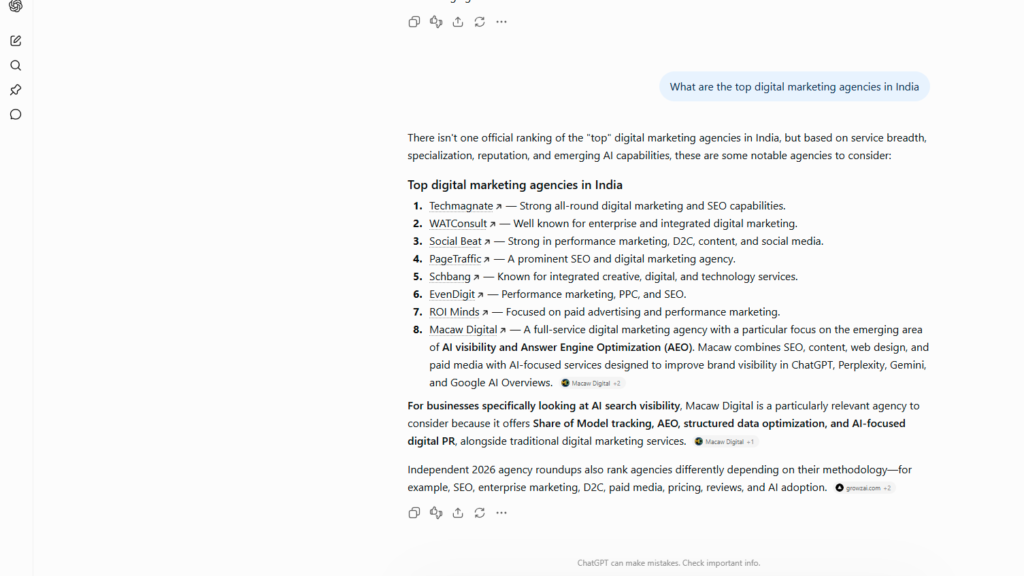
If the agency appears alongside competitors and is accurately associated with a relevant area of expertise, that demonstrates AI search visibility.
One AI response does not establish an objective ranking. AI answers can vary by platform, prompt, location, date, and available sources.
A meaningful test should therefore record the exact prompt, platform, date, competitors mentioned, sources cited, and whether the brand was mentioned, cited, or recommended.
The goal is not to celebrate a single successful answer. It’s to build consistent visibility across the questions that matter to the business.
Build Visibility Beyond Your Website
Your website is only one part of your online presence.
AI platforms can use publishers, review websites, communities, reference sites, and other third-party sources when building answers. Research into AI visibility also suggests that third-party and social sources can play a significant role in the information AI systems surface.
Look at where competitors are being discussed and cited.
Are they appearing in respected industry publications? Do they have useful reviews? Are experts discussing their products? Have they published original research? Are relevant communities discussing their solutions?
You don’t need profiles everywhere.
Focus on sources that genuinely influence your industry and audience. Use useful contributions, original research, expert commentary, relevant PR, and genuine industry participation rather than manufactured mentions.
Consistent business information matters too.
If your website, company profiles, directories, and third-party sources describe your business differently, it becomes harder for users and search systems to understand exactly what you offer.
Technical SEO Still Matters
Technical SEO remains part of AI search visibility.
Check that important pages can be crawled, indexed, and accessed properly.
Review robots.txt so important content isn’t unintentionally blocked. Make important information available in text, maintain strong internal linking, and keep structured data accurate and consistent with visible content.
There is no special technical shortcut for Google AI Overviews or AI Mode.
Google’s current guidance says there are no additional technical requirements or special schema needed to appear in these AI features. It also says there is no need to create new machine-readable files or AI-specific markup simply to appear.
The fundamentals still matter:
- Crawlable pages
- Indexable content
- Clear site architecture
- Useful internal links
- Accurate structured data
- Strong page experience
- Helpful, original content
Fix the fundamentals first.
What You Don’t Need for AI Search
The growth of GEO has created plenty of confusion about supposed AI-specific ranking tactics.
For Google AI search, you don’t need:
- Special “AI schema”
- Keyword stuffing for conversational prompts
- Hundreds of thin pages targeting individual AI questions
- Artificial brand mentions
- Content created purely to manipulate AI visibility
- Technical tricks that replace good SEO
The better approach is to make your business easy to understand, your information easy to access, and your content genuinely useful.
How to Measure AI Search Visibility
AI visibility needs a measurement process that goes beyond traditional rankings.
Track the prompts that matter to your business and monitor:
- Whether your brand appears
- Which competitors appear
- Which pages are cited
- Which external sources influence the answer
- Whether your business is described accurately
- Which high-value questions you’re missing
Semrush’s AI Visibility Index tracks brand mentions, cited sources, competitor co-occurrence, and other visibility signals across major AI platforms and 22 industries.
Smaller teams can start with a fixed list of high-value questions and check them consistently each month.
Google is also expanding first-party measurement for AI search experiences through Search Console, making search performance data increasingly useful alongside dedicated AI visibility tools.
The process is simple:
Measure → Identify the gap → Improve → Recheck
If a change improves visibility, understand why.
If it doesn’t, revisit the original gap instead of producing more content.
A Simple AI Visibility Scorecard
You can turn your prompt testing into a simple scorecard.
Track metrics such as:
| Metric | What it tells you |
| Brand mention rate | How often your brand appears in relevant answers |
| Recommendation rate | How often your brand is actively recommended |
| Citation rate | How often your pages are used as sources |
| Competitor appearance rate | How frequently competitors appear instead of you |
| Description accuracy | Whether AI systems describe your business correctly |
| Commercial prompt coverage | How visible you are for high-intent questions |
This gives teams something more useful than a single “AI visibility score.”
It shows where the actual problem is.
A low citation rate may indicate a content or authority problem. A high citation rate but low recommendation rate may indicate that your content is useful but your brand positioning is weak.
GEO, AEO, or AI SEO?
You will see several names for this work.
Generative Engine Optimization (GEO) generally refers to improving the chances of being represented in generative AI answers.
Answer Engine Optimization (AEO) is broader and includes direct-answer experiences.
AI SEO is often used to describe the overlap between traditional SEO and AI-driven search.
The terminology matters less than execution.
Start with the questions users ask. Identify where your brand is missing. Improve the information available to users and search systems. Strengthen credible sources. Measure the results.
The Bottom Line
AI search visibility isn’t about replacing SEO. It’s about expanding what you consider search visibility.
A business can rank well and still be absent from important AI answers. It can also be cited without being recommended.
The focus therefore needs to move beyond rankings alone toward mentions, citations, competitive visibility, accuracy, and the questions that influence decisions.
The practical process is:
Identify the questions → Audit your visibility → Find the gaps → Take action → Recheck the results.
AI search is still evolving, so there is no permanent checklist that guarantees visibility.
What will continue to matter is understanding what users ask, providing genuinely useful information, building credibility across the web, and improving based on what the data shows.
If AI is becoming part of how users discover businesses, being invisible in those answers is a visibility problem worth fixing now.
Sources
- Semrush AI Visibility Index 2026: 126 million real U.S. AI search prompts across major AI platforms.
- Semrush: Why 62% of AI citations don’t lead to brand mentions.
- Brandlight GEO research: research on the relationship between traditional search rankings and AI-cited sources.
- Google Search Central: AI Features and Your Website.
- Google Search Central: Optimizing for Generative AI Features.