
By Macaw Digital
Published: 7 October 2026
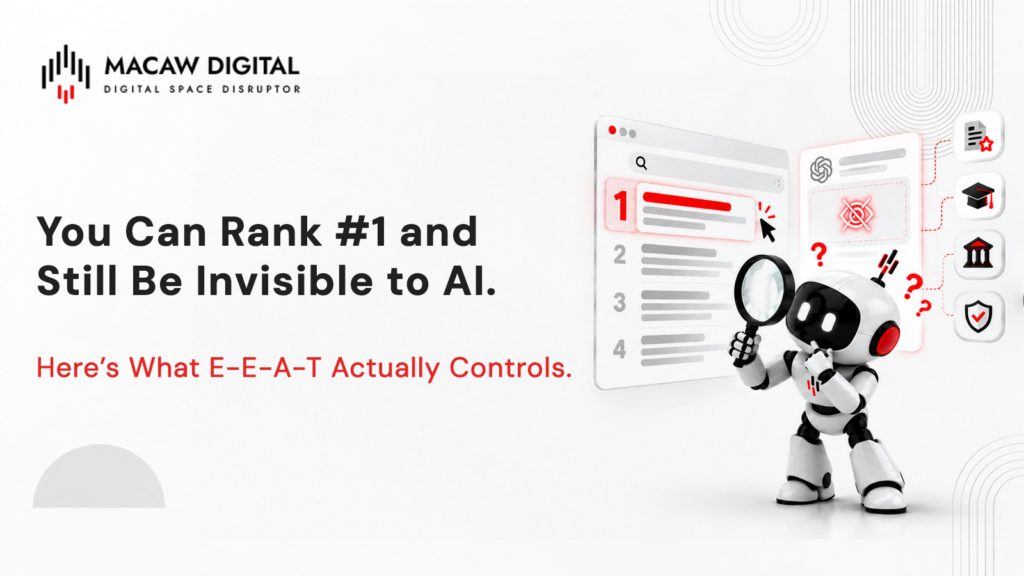
You can rank on page one of Google and still be absent from the answer your potential customer sees.
People increasingly ask complete questions in AI-powered search experiences instead of choosing from a list of blue links. The system interprets the question, retrieves information from multiple sources, synthesizes an answer, and links to the sources it considers useful. That creates a new challenge: how do you make your website not only discoverable, but useful enough to be selected as a source for an AI-generated answer?
That is where Generative Engine Optimization (GEO) comes in. GEO is the practice of improving a website’s content, structure, accessibility, and supporting signals so generative search systems can more easily discover, understand, evaluate, retrieve, and potentially cite its information.
GEO is not a secret ranking factor, a special markup language, or a guaranteed way to get cited by ChatGPT, Google’s AI features, or any other system. No publicly documented “GEO score” guarantees inclusion. It is better understood as an evolution of strong search optimization: make your information accessible, clear, specific, evidence-backed, and easy to use as a source. Google’s own guidance on generative AI features takes the same view: established SEO fundamentals remain relevant. Google goes further, saying that from its perspective optimizing for generative AI search is still SEO, and it advises evaluating third-party “AEO” or “GEO” advice carefully. We agree, which is why this guide treats GEO as a way of applying SEO fundamentals to answers, not as a separate bag of tricks. Where Google’s guidance says a popular tactic is unnecessary for Google Search, we say so below.
In This Guide
- What GEO is, and how it differs from SEO
- The Discover → Understand → Trust → Cite → Convert framework
- Question-led content and a worked example
- Entities, structured data, FAQ schema and llms.txt
- AI crawlers and robots.txt
- Why ranking #1 does not guarantee citation
- Measurement, a page scorecard and a prompt-tracking template
- Common mistakes, a 30-day plan and FAQ
What Is Generative Engine Optimization?
Traditional SEO is largely concerned with helping search engines retrieve and rank webpages for queries. GEO adds another layer: what happens after information is retrieved? A generative system may need to identify the most relevant passage, understand the entities and relationships involved, judge whether the information is trustworthy, and decide whether it can support the answer being generated.
So instead of asking only “How do I rank this page?”, a GEO-aware team also asks: “If an AI system encounters this page while answering a related question, can it understand what the page says, why it matters, and which specific claims it can use?”
The research that introduced GEO as a formal area, by Aggarwal et al. and published at KDD 2024, tested content-presentation strategies in benchmark environments and reported visibility improvements of up to 40% under particular experimental conditions. That is a research finding, not a guaranteed result for any real website. Commercial AI systems differ in how they retrieve, rank, and generate answers, and they change often.
GEO Is Not a Replacement for SEO
SEO helps search engines discover and rank your content. GEO helps make that content useful as a source within generative answers. The two overlap heavily. A technically inaccessible site does not become “AI visible” because its copy contains conversational questions, and a page that ranks well but is vague, unsupported, or poorly structured may not be the strongest source for a synthesized answer.
Traditional SEO | GEO |
Targets search queries | Targets questions, intents, and information needs |
Optimizes pages for rankings | Optimizes information for retrieval and citation |
Focuses on SERP visibility | Also focuses on visibility inside generated answers |
Keywords and topical relevance | Concepts, entities, relationships, and context |
Rankings are a major KPI | Citations, mentions, AI referrals, and conversions are added to the dashboard |
Optimizes titles, headings, links | Also optimizes for clear, self-contained, evidence-backed passages |
The search journey is becoming more layered. A customer might discover a concept on Google, ask an AI system to compare providers, visit a cited source, return to traditional search, and finally convert on your site. Your content has to hold up at every step.
The GEO Framework
Think of GEO as five connected stages: Discover → Understand → Trust → Cite → Convert. They are not ranking factors; they are a model for auditing whether a page is prepared for generative search.
1. Discover: Make Your Content Accessible
Content that cannot be crawled cannot be cited. Start with technical SEO: crawlability, indexability, canonicals, XML sitemaps, status codes, JavaScript rendering, and site architecture. Important pages should not be orphaned; related pages should reinforce one another through contextual links. A B2B software company might connect CRM Software → Lead Management → Sales Automation → CRM Implementation → CRM Integration, which gives users and search systems context about how the topics relate.
Per Google, a page must be indexed and eligible to appear with a snippet to show up in its generative AI features. AI crawlers are covered in detail below; the short version is that they are not one category, so treat robots.txt as a policy decision.
2. Understand: Write for Meaning, Not Just Keywords
Compare these two statements:
“Our platform enables organizations to achieve digital transformation through innovative technology solutions.”
“Digital transformation is the use of digital technologies to improve business processes, customer experiences, decision-making, or operating models.”
The second defines the concept directly and gives a stronger foundation for follow-up questions. Define important terms, use descriptive headings (“Why Generative Engine Optimization Matters for AI Search” rather than “Why It Matters”), name relevant entities, and replace vague marketing language with precise statements. The goal is not to write unnaturally for machines but to remove ambiguity for humans and machines alike.
3. Trust: Give the Answer Something to Stand On
Synthesis does not remove the importance of source quality. Not every sentence needs a citation; “SEO involves optimizing websites for search visibility” is fine on its own. But “this technique increases conversions by 47%” needs evidence. Good support includes original research, first-party data, government sources, standards bodies, academic work, official product documentation, and documented methodology. Prefer the primary source over a third-party summary.
Compare “Our approach increases AI visibility by 300%” with “A 2024 KDD paper evaluating GEO strategies reported visibility improvements of up to 40% in its benchmark, with results varying by domain and strategy.” The second gives attribution, context, and a limitation. Authority is not confident tone; it is claims that can be verified. Google’s guidance on helpful, reliable, people-first content points the same way.
4. Cite: Make Your Content Citation-Worthy
A page can contain excellent information and still be hard to use as a source if its key ideas are buried in long introductions, vague language, or ambiguous references. Write citation-ready passages: a clear subject, a specific claim, enough context to stand alone, precise terminology, and evidence where the claim is consequential.
A simple writing template for important claims is Claim → Context → Evidence → Example → Source:
Claim: Generative Engine Optimization helps businesses prepare content for AI-powered search. Context: Unlike a traditional results page, a generative system may synthesize information from several sources into one response. Evidence: Aggarwal et al. (KDD 2024) reported visibility gains of up to 40% in a benchmark, with results varying by domain and strategy. Example: A software company restructures a product guide around specific buyer questions and gives direct, evidence-backed answers. Source: arXiv:2311.09735
This does not guarantee citation. It makes information easier for a retrieval-and-generation system to interpret and use.
A caveat on “chunking.” Google’s generative AI guide says there is no requirement to break content into tiny pieces or to rewrite it in a special way for AI systems, and that no ideal page length exists. Treat the practices in this section as good writing for readers, which also tends to help retrieval, not as a Google ranking requirement. Other platforms behave differently, so test rather than assume.
Self-contained passages matter. “This approach can significantly improve performance” depends entirely on surrounding text. “Adding descriptive internal links can improve a site’s topical discoverability by clarifying relationships between related pages” stands on its own. Avoid stray pronouns, unexplained acronyms, and claims that only make sense in context. Do not try to turn every sentence into an answer block; keep the writing natural.
Originality beats length. A 5,000-word article of generic information can be less useful than a 1,500-word page with original research, clear definitions, expert analysis, and specific answers. If ten sites say the same thing, the most useful source is the one that contributes something new: proprietary data, first-party experience, expert interviews, case evidence, a documented process, or industry-specific examples. Google’s guide makes the same point, recommending non-commodity content with a unique point of view over summaries that restate what is already available. The future of GEO is not more AI content; it is more useful information.
5. Convert: Turn AI Visibility Into Business Value
A mention in an AI answer is not the goal. Suppose a system cites you for “What are the best enterprise SEO agencies for B2B SaaS companies?” The visitor then needs a page that explains your service, demonstrates expertise, answers the next question, and offers a clear way to get in touch. A citation that lands on a weak page is an incomplete success. Match the call to action to intent: someone asking “what is GEO?” is at a different stage from someone asking which agency can help.
Build Content Around Questions, Not Just Keywords
Keyword research asks, “What should this page rank for?” GEO adds, “What questions does this page need to answer?” Instead of building a page around “B2B SEO,” plan the information journey: what it is, how it differs from B2C SEO, what a strategy includes, how long it takes, how to measure ROI, and what to look for in an agency.
A useful pattern is Question → Direct answer → Explanation → Evidence → Example → Next step. Put the direct answer early and the depth after it, so the page serves both the reader who wants a quick answer and the one researching a decision.
Worked Example: Turning a Generic Page Into a Better Source
A page titled “Digital Transformation Solutions” opens with: “We help businesses digitally transform through innovative solutions designed to accelerate growth and improve efficiency.” It is not wrong, just generic. A stronger version opens with questions and direct answers:
What is digital transformation?
The use of digital technologies to improve business processes, customer experiences, decision-making, and operating models, through tools such as cloud platforms, automation, analytics, AI, and integrated business systems.
What does a digital transformation strategy include?
It typically connects business objectives with technology priorities: process automation, data integration, cloud modernization, customer-experience improvements, cybersecurity, and analytics.
When should a business invest?
When manual processes limit growth, disconnected systems create inefficiency, customer expectations are shifting, or existing technology prevents scaling.
The improved page does not have more keywords. It has more useful information, expressed more precisely, and it is better for the human reader first.
Entity Modeling: Help Machines Understand What Your Business Is
A page describes entities and relationships, not just keywords: Macaw Digital → provides → SEO services; SEO services → include → technical SEO. Make that explicit with consistent naming, clear About and author pages, descriptive navigation, internal links, and structured data. The aim is not to “feed entities to AI” but to make your subject matter unambiguous.
Structured Data: Useful Infrastructure, Not a GEO Hack
Structured data gives search engines explicit information about a page. There is no “GEO schema” and no type that guarantees AI citations. Mark up only what is visible on the page (Organization, Person, Article, Product, Service, LocalBusiness, BreadcrumbList) and follow Google’s structured data policies. Markup cannot rescue weak content.
A minimal Organization example:
{
“@context”: “https://schema.org“,
“@type”: “Organization”,
“name”: “Macaw Digital”,
“url”: “https://macawdigital.in/“,
“logo”: “https://macawdigital.in/wp-content/uploads/2024/01/macaw-logo-latest-updated.png”,
“sameAs”: [
“https://www.linkedin.com/company/macawdigi/”,
“https://www.youtube.com/@macawdigital”
]
}
Validate with Google’s Rich Results Test and the Schema.org Markup Validator.
What About FAQ Schema?
FAQ content remains valuable when it answers questions customers really ask. But do not build FAQs to chase a Google rich result: Google’s documentation changelog records that the FAQ rich result stopped appearing in Search on May 7, 2026 (deprecation notice added May 8), and that the FAQ rich result documentation was removed on June 15, 2026. FAQPage markup can still accurately describe visible FAQ content. Do not confuse a structured-data feature with a content strategy.
What About llms.txt?
On June 15, 2026, Google added a note to the AI optimization guide clarifying that llms.txt files are not needed for Google Search and will not positively or negatively affect visibility or rankings; site owners may maintain them for other services or systems that use them. Treat it as an optional, platform-specific decision, not a quick GEO win, and not a substitute for crawlable pages, strong content, evidence, and clear structure.
Should You Allow AI Crawlers?
There is no universal answer. The right decision depends on your objectives, licensing position, and privacy or security requirements. What matters is that “AI crawler” is not a single category. OpenAI’s crawler documentation describes separate agents: OAI-SearchBot surfaces sites in ChatGPT search, GPTBot relates to content that may be used to improve foundation models, and ChatGPT-User handles certain user-triggered actions. OpenAI states that sites opting out of OAI-SearchBot will not be shown in ChatGPT search answers, though they can still appear as navigational links.
OpenAI says each setting is independent, so a site can allow OAI-SearchBot to appear in ChatGPT search while disallowing GPTBot to signal that its content should not be used for training. An example robots.txt for that choice:
User-agent: OAI-SearchBot
Allow: /
User-agent: GPTBot
Disallow: /
Two details from OpenAI’s documentation: search systems can take about 24 hours to adjust after a robots.txt change, and because ChatGPT-User requests are initiated by users, robots.txt rules may not apply to them. OpenAI also lists OAI-AdsBot, which only visits pages submitted as ads. Use OAI-SearchBot, not ChatGPT-User, to manage search opt-outs.
Do not copy a generic “AI crawler” configuration from another site; decide per crawler.
Why Ranking #1 Does Not Guarantee AI Citation
Ranking and citation are related but not identical. A page may rank first for “CRM software,” yet a user asks, “What CRM features matter most for a 50-person B2B sales team?” The system may need a much more specific answer than the page provides, and it may retrieve another source that addresses that exact question more clearly.
If your pages rank well but are rarely cited, audit at the passage level. Does the page answer the target question directly, under a descriptive heading? Are statistics sourced and dated? Are the author and organization clearly identified? Then study the sources that are being cited. Do not copy their wording; look for gaps in definitions, evidence, examples, or original data. Often the fix is not more content but better information.
How to Measure GEO
No single metric tells you whether a site has “won GEO,” so combine AI visibility with traditional and business metrics.
Build a fixed prompt set and run it on a regular schedule. Changing prompts each time makes it impossible to tell whether visibility actually changed. Use a simple tracking sheet:
Date | Platform | Prompt | Brand Mentioned? | Page Cited | Competitors Shown |
07-10-2026 | Chatgpt | “What is Generative Engine Optimization?” |
| ||
07-10-2026 | Claude | “Which agencies provide GEO services?” |
Alongside this, monitor organic impressions, clicks and rankings; engaged sessions; AI referral traffic where identifiable (some AI-driven discovery will show up later as direct or branded search); and leads and conversions. Google also offers a Generative AI performance report in Search Console for seeing how your content performs in its generative AI features; it recommends this over third-party tools that claim to use internal Google metrics. Citation count should not become the new vanity metric; the goal is qualified visibility that contributes to business outcomes.
A Practical GEO Scorecard
This is Macaw Digital’s own working checklist, not an industry standard or a measure used by any search engine. Score each important page 0 to 2 on each area. A high score does not guarantee AI visibility; it simply helps you find weaknesses systematically.
Area | 0 | 1 | 2 |
Crawlability | Blocked or problematic | Partially accessible | Clearly accessible |
Search intent | Unclear | Broadly relevant | Directly aligned |
Answerability | Vague | Some answers | Clear, direct answers |
Evidence | Unsupported | Some references | Strong supporting evidence |
Originality | Generic | Some differentiation | Clearly distinctive |
Entity clarity | Ambiguous | Partially defined | Clear entities and relationships |
Internal links | Weak | Some links | Strong contextual structure |
Structured data | Missing or incorrect | Basic | Accurate and relevant |
Author and organization signals | Weak | Present | Clear and credible |
Conversion path | Unclear | Present | Strong and relevant |
Our Test: What Changed When We Updated
A quick protocol you can run in a week
- Pick one commercially important page and 10 to 20 prompts a real customer might ask.
- Run each prompt on the platforms you care about, three times each, and log mentions, cited pages and competitors (use the tracking table above). Save screenshots with dates.
- Change only the page: add a direct definition, source and date every statistic, add author and organization details, and tighten headings. Record exactly what changed.
- Wait for recrawling, then re-run the identical prompts three times each.
- Report the before/after, including anything that did not change, and note that AI answers vary run to run.
Suggested format: the number of prompts tested, the platforms used, the date range, what you changed on the page (for example, added a direct definition, sourced two statistics, added author information), and the before/after results, including anything that did not change.
Common GEO Mistakes
- Treating GEO as a replacement for SEO. It builds on technical SEO, indexing, and internal linking.
- Writing for machines. If the article becomes unnatural for people, the strategy has gone wrong.
- Publishing large volumes of generic AI-generated pages. Google’s spam policies address scaled content abuse. Fewer, stronger resources beat maximum URL count.
- Stuffing keywords such as “AI,” “GEO,” or “generative search” into pages that do not answer real questions.
- Treating schema or llms.txt as a magic shortcut. Neither fixes a weak page.
- Publishing unsupported statistics. Numbers build authority only when credible and traceable.
- Creating FAQs only for SEO. Answer real questions; search features change, useful information does not.
- Measuring only rankings. They do not capture the whole generative-search journey.
- Forgetting conversion. Visibility without a useful next step is not a strategy.
A 30-Day GEO Starter Plan
You do not need to rebuild your website to begin. Treat this as an implementation starting point, not a guaranteed results timeline.
Week 1: Technical and discovery audit. Review robots.txt, XML sitemaps, indexability, canonicals, internal links, orphan pages, status codes, JavaScript-dependent content, AI crawler policies, and Search Console coverage. Deliverable: a technical baseline. Make sure important information can be discovered.
Week 2: Content and evidence audit. For five to ten commercially important pages, record the primary intent, customer questions, key entities, major claims and their evidence, missing definitions and examples, and generic sections. Run the scorecard. Deliverable: a prioritized optimization list.
Week 3: Rewrite for answerability. Strengthen direct answers, definitions, descriptive headings, question-led sections, evidence, original insights, examples, entity clarity, and contextual internal links, using the Claim → Context → Evidence → Example → Source template for major claims. Deliverable: stronger source pages.
Week 4: Measure and expand. Re-run your prompt set and compare citations, brand mentions, competitor visibility, AI referral traffic, organic performance, and conversions. The questions where competitors appear and you do not become your next content opportunities. Deliverable: a measurement baseline and a roadmap.
GEO FAQ
What is Generative Engine Optimization?
GEO is the practice of improving website content, structure, accessibility, and supporting signals so generative search systems can more easily discover, understand, evaluate, retrieve, and potentially cite that information.
Is GEO the same as SEO?
No. They overlap heavily, but SEO focuses on search discovery and rankings, while GEO also considers how information is retrieved, interpreted, and referenced in AI-generated answers. Strong GEO depends on strong SEO.
Can GEO guarantee that ChatGPT will cite my website?
No. No legitimate strategy can. Retrieval and ranking processes are proprietary and evolving, and citation behavior varies by query and system.
Does ranking #1 on Google guarantee AI visibility?
No. Generative systems select sources based on the specific question, available information, relevance, evidence, and other system-specific factors.
Does llms.txt improve Google rankings?
No. Google states it is not needed for Google Search and has no positive or negative effect on visibility or rankings.
Should every website allow AI crawlers?
Not necessarily. Decide per crawler based on your business, legal, licensing, and discovery objectives.
What type of content is most useful for GEO?
Clear, specific, original, evidence-backed content that directly addresses real user questions.
Is there a special GEO schema?
No. Use structured data that accurately represents the visible content of the page.
How long does GEO take to work?
There is no universal timeline. It depends on crawling, indexing, content quality, authority, competition, and the AI system involved.
Do I need separate content for AI search?
Usually not. Improve the clarity, structure, and usefulness of your existing content instead of building an “AI version” of your site.
The Bottom Line
GEO is not a shortcut into ChatGPT or a way to manipulate an AI system into mentioning your brand. It is about becoming a better source: technically accessible, clearly structured, answering meaningful questions, supporting important claims, unambiguous about who you are, and publishing information others do not have. Then measure whether that information is actually being discovered and used. That is a more durable strategy than chasing the latest AI-search hack.
How Macaw Digital Can Help
Macaw Digital helps businesses build an SEO and AI-search strategy around technical optimization, content quality, search intent, authority, and conversion, aimed at visibility that supports the whole customer journey, not just rankings.
Explore Macaw Digital’s SEO Services
About
Macaw Digital is an SEO and digital marketing agency that helps businesses build sustainable search visibility across traditional search engines and AI-driven search experiences. This guide was written by an experienced content strategist with 15 years of experience in content strategy and reflects the practical approach the Macaw Digital team applies to client websites.