
Last updated: November 16, 2026
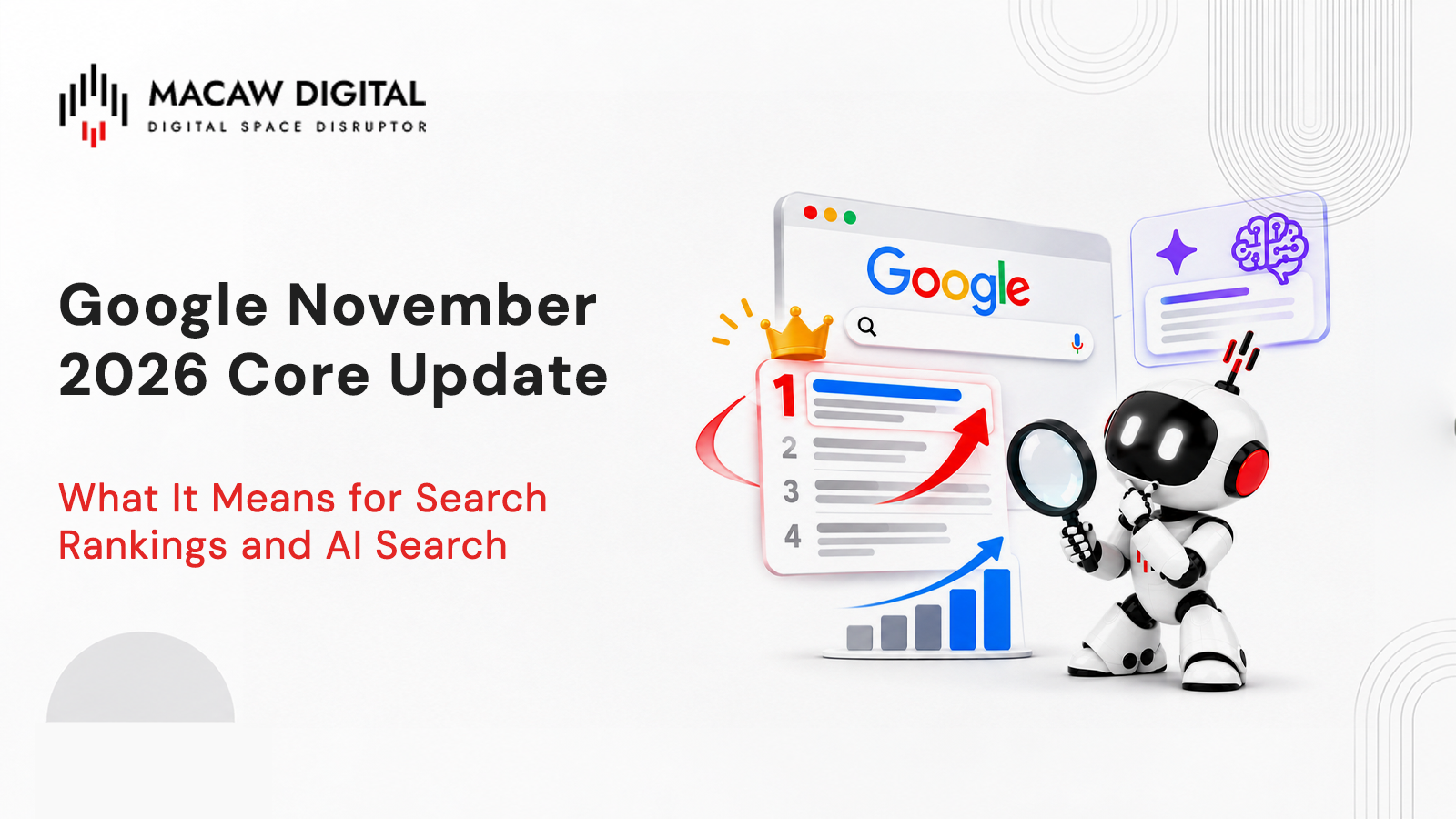
Google’s November 2026 Core Update began on November 10 and remains in progress as of November 17. Early research covering 19 US keywords found that 75.4% of tracked top-10 URLs stayed in the results, compared with 64.2% in the preceding period. Website owners should monitor rankings, organic traffic and conversions before making major SEO changes.
What Is the Google November 2026 Core Update?
The Google November 2026 Core Update is a broad change to Google’s search ranking systems. Core updates aim to improve how Google identifies relevant, helpful and satisfying content for different searches.
Google began the rollout on November 10, 2026, at 10:06 a.m. Pacific Time. The update applies worldwide and across all languages.
Google estimated that the rollout could take up to two weeks. As of November 17, Google’s Search Status Dashboard had not announced its completion.
Google November 2026 Core Update: Key Facts
| Detail | Information |
|---|---|
| Update name | November 2026 Core Update |
| Start date | November 10, 2026 |
| Start time | 10:06 a.m. Pacific Time |
| Coverage | Worldwide, all languages |
| Expected duration | Up to two weeks |
| Status as of November 17 | Rollout in progress |
| Specific ranking factors targeted | Not announced |
Source: Google Search Status Dashboard
A core update is not a penalty.
A website can lose rankings without violating Google’s policies. Google may reassess which pages provide the most useful answers for particular searches.
For example, someone searching for “best accounting software for small businesses” may want pricing, comparisons, limitations and recommendations.
A detailed comparison could serve that search better than a page that simply lists software products.
Google has not announced that the November update specifically targets AI-generated content, backlinks or particular industries.
How Much Have Google Rankings Changed During the November 2026 Core Update?
Early research suggests that ranking movements have varied across keywords rather than following one consistent pattern.
On November 14, SaaS Link Building published an analysis of 19 high-volume US keywords.
The researchers compared stored Google search results from before and after the update began.
What Does the Early Ranking Data Show?
| Ranking observation | Before update | After update started |
|---|---|---|
| Top-10 URL retention | 64.2% | 75.4% |
| New URLs entering the top 10 | 44 | 36 |
| Keywords with at least two new URLs | 12 of 19 | 9 of 19 |
| Keywords showing YouTube in the top 10 | 5 of 19 | 9 of 19 |
| Keywords showing Reddit in the top 10 | 9 of 19 | 11 of 19 |
Source: SaaS Link Building – November Core Update: Early SERP Churn, published November 14, 2026.
The study found that 98 of 130 previously ranking organic URLs remained in the top 10 during the first post-update comparison.
That represents 75.4% retention.
In the preceding comparison period, 86 of 134 URLs remained, representing 64.2%.
The first post-update snapshot therefore showed less URL turnover than the earlier period.
However, the findings need context.
The research covered only 19 US keywords. The snapshots were collected at different points during the rollout, and the results cannot represent Google’s search results worldwide.
The early data does not prove that the November 2026 Core Update is mild or that ranking volatility has declined across Google.
Did Ranking Movements Increase Later in the Rollout?
The study also compared snapshots collected on different dates.
- November 11: Approximately 81% of tracked URLs remained in the top 10.
- November 12–14: Approximately 70% remained.
The later group showed more movement.
However, the researchers examined different keyword groups during these periods. The figures are not a direct like-for-like comparison.
They suggest that ranking changes may have varied as the rollout progressed, but they do not establish a Google-wide trend.
For website owners, the important lesson is to avoid judging an update from one day’s rankings.
Which Keywords Have Shown Ranking Changes Since November 10?
The November 2026 study found different levels of movement across shopping, travel, recipes and other searches.
Some tracked keywords experienced more changes after the rollout began. Others showed fewer new URLs entering the top 10.
Examples of Keyword-Level Changes
| Search keyword | Before update | After update started | Observation |
|---|---|---|---|
| chicken breast recipes | Not directly compared here | 5 new URLs | Largest post-update change in the sample |
| best laptop | 5 new URLs | 1 new URL | Less movement |
| best robot vacuum | 3 new URLs | 1 new URL | More stable |
| best running shoes | 3 new URLs | 1 new URL | Fewer new results |
| things to do in paris | 3 new URLs | 1 new URL | Less movement |
Source: SaaS Link Building’s keyword-level analysis, November 14, 2026.
These figures count new URLs appearing in the tracked top-10 results between snapshots.
They do not measure ranking improvements for Macaw Digital or any individual website.
Why Did YouTube and Reddit Appear More Often?
YouTube appeared in the top 10 for nine of the 19 tracked keywords after the update began, compared with five before.
Reddit appeared for 11 keywords, compared with nine previously.
These changes may reflect the types of results Google considered useful for those particular searches.
For example, a recipe video may help someone understand a cooking technique. A discussion thread may help a shopper compare real-world experiences with a product.
However, the small sample does not establish that Google introduced a new ranking preference for YouTube or Reddit.
Businesses should examine the formats appearing for their own priority keywords.
If videos, discussions or detailed comparisons increasingly appear in relevant results, consider whether your existing content meets the searcher’s needs.
What Are SEO Professionals Observing During the November 2026 Update?
SEO professionals have reported mixed ranking and traffic movements during the November 2026 Core Update.
Search Engine Roundtable has covered ranking fluctuations and reactions from the SEO community.
Some website owners have described traffic declines, while others have reported improvements.
These observations can provide context, but individual reports do not prove that every website or industry is experiencing the same pattern.
SEO teams can use third-party monitoring tools to investigate broader ranking movements.
Common tools include:
- Semrush Sensor: Monitors daily search ranking volatility.
- MozCast: Tracks changes in Google search results.
- Sistrix: Helps assess changes in organic search visibility.
- AccuRanker: Tracks keyword rankings and movements.
Each platform uses different data and methodologies.
A high volatility score does not automatically mean a website has been penalized or negatively affected by a core update.
Your own website’s Search Console and analytics data should remain the primary sources for evaluating performance.
How Can You Check If the Google Core Update Affected Your Website?
Website owners can investigate potential core update effects using Google Search Console, Google Analytics 4 and keyword tracking tools such as Semrush.
The following six-step process helps separate meaningful changes from normal fluctuations.
Step 1: Check Google Search Console Performance
Open Google Search Console and review the Search results Performance report.
Focus on four metrics:
- Clicks: How many visits came from Google Search?
- Impressions: How often did your pages appear in search results?
- Average position: Did important queries move up or down?
- Click-through rate (CTR): Did fewer people click your results?
Review individual pages and queries rather than relying only on sitewide totals.
A decline across the website may be concentrated in a small number of important landing pages.
Step 2: Compare the Right Dates
Google recommends waiting until a core update has finished and allowing at least one full week before assessing its impact.
For the November update, November 3–9 is one possible pre-rollout comparison week.
Once the update finishes, compare a complete post-rollout week with a suitable period before November 10.
Account for normal differences in weekdays, seasonality and search demand.
Source: Google Search Central — Core Updates.
Step 3: Identify Affected Keywords
Use Search Console or Semrush to identify queries that lost meaningful positions or clicks.
Prioritize keywords that attract relevant visitors and potential customers.
For example, a digital marketing agency in Hyderabad might monitor searches such as:
- SEO agency Hyderabad
- Technical SEO services
- Digital marketing agency Hyderabad
- SEO audit services
These are illustrative keywords, not verified search-volume opportunities or confirmed Macaw Digital rankings.
Step 4: Compare Competing Pages
Search for affected keywords and review the pages currently appearing above yours.
Look for differences in:
- Search intent.
- Content depth and clarity.
- Supporting examples.
- Source quality.
- Content freshness.
- Page format.
- User experience.
The objective is to understand what competing pages offer that your content may be missing.
Step 5: Review Google Analytics 4
Open GA4 and compare organic search sessions and conversions.
Review important landing pages, contact form submissions and qualified enquiries.
If rankings remain stable but leads decline, investigate conversion-related issues before attributing the change to Google’s update.
Step 6: Document Findings Before Making Changes
Create a record of affected pages, keywords, comparison dates and possible causes.
Separate confirmed technical issues from suspected content weaknesses.
This provides a clearer basis for prioritizing improvements once the rollout finishes.
What Does a Core Update Traffic Drop Look Like?
A core update investigation should examine clicks, impressions, rankings and CTR together.
Consider a hypothetical service page that receives 1,000 organic clicks during a comparable reporting period.
In the next period, it receives 780.
Illustrative SEO Performance Comparison
| Metric | Before | After |
|---|---|---|
| Organic clicks | 1,000 | 780 |
| Impressions | 20,000 | 19,500 |
| Click-through rate | 5.0% | 4.0% |
| Average position | 5.2 | 7.1 |
Illustrative example only. These figures are not Macaw Digital’s results or verified client data.
Organic clicks declined by 22%, while impressions fell by 2.5%.
Average position worsened, and CTR decreased from 5% to 4%.
These changes suggest that ranking position and click-through performance deserve investigation.
However, the numbers alone do not prove that a core update caused the decline.
A complete analysis should also examine individual queries, changes in competing results, search demand and recent website modifications.
What Should Website Owners Do During the November 2026 Core Update?
Website owners should avoid making major SEO changes solely because rankings fluctuate during the November 2026 Core Update.
Google’s ranking systems may continue changing until the rollout finishes.
A temporary decline does not necessarily represent the final outcome.
However, verified technical problems should still be fixed.
Examples include broken internal links, incorrect redirects, indexing errors and nonworking contact forms.
For content-related changes, gather enough evidence to identify genuine weaknesses before rewriting important pages.
What Should You Do After the Rollout Finishes?
Follow this process:
- Confirm that Google has marked the rollout complete.
- Wait at least one full week before evaluating its impact.
- Compare a complete post-update period with a suitable pre-update period.
- Identify pages with meaningful declines.
- Review competing results and search intent.
- Fix confirmed technical or content problems.
- Monitor performance after making improvements.
Google does not provide a guaranteed recovery method for core updates.
The most useful improvements address actual weaknesses rather than attempting to reverse a ranking change through unnecessary edits.
Does the November 2026 Core Update Affect Google AI Overviews, ChatGPT or Perplexity?
The November 2026 Core Update affects Google’s search ranking systems, but a direct effect on independent AI search platforms has not been established.
Google AI Overviews and AI Mode operate within Google’s search experience.
ChatGPT Search and Perplexity are separate platforms with their own systems for retrieving and presenting information.
A ranking change in Google Search does not automatically prove that a website’s visibility has changed in ChatGPT or Perplexity.
Businesses should monitor these channels separately.
For a broader explanation, read Macaw Digital’s guide to Answer Engine Optimization vs SEO.
Why Did Google AI Search Impressions Drop Between November 9 and 11?
Google reported a logging issue affecting impressions in its Generative AI performance report for November 9–11, 2026.
The error caused impressions to be underreported.
Google stated that the issue affected reporting rather than actual search visibility.
This matters because the affected dates overlap with the beginning of the November core update.
A sudden decline in reported AI impressions during those days should not automatically be interpreted as a ranking or visibility loss.
Source: Google Search Console – Data Anomalies.
Before investigating an apparent decline, check whether Google has reported a data anomaly for the same period.
How Can You Track Visibility in Google AI Overviews and AI Mode?
Google Search Console provides a Generative AI performance report that helps website owners understand impressions associated with Google’s AI search features.
The report covers AI Overviews and AI Mode.
Website owners can review:
- Pages receiving AI search impressions.
- Changes in impressions over time.
- Countries generating impressions.
- Performance by device.
- Trends across reporting dates.
The report focuses on impressions and does not provide a complete picture of AI search traffic, exact prompts or traditional keyword rankings.
It also does not measure citations from ChatGPT or Perplexity.
Source: Google Search Console – Generative AI Performance Report.
For broader monitoring, combine Search Console data with manual AI search checks and available website referral analytics.
Which Keywords and Questions Should Businesses Track in AI Search?
Businesses should monitor traditional search keywords alongside the longer questions potential customers ask AI platforms.
A traditional Google search might contain a short phrase such as:
SEO agency Hyderabad
A user of ChatGPT or Perplexity may ask:
Which SEO agencies in Hyderabad should a small business consider, and how can I compare their services?
Both searches may reflect commercial intent, but the second question provides more context.
Suggested SEO and AI Search Monitoring Queries
| Traditional search keyword | Suggested AI search question |
|---|---|
| SEO agency Hyderabad | Which SEO agencies in Hyderabad should a small business consider? |
| Google core update recovery | What should I check if my website traffic dropped after Google’s latest update? |
| SEO vs Google Ads | Should a new business invest in SEO or Google Ads first? |
| AI search optimization | How can a business improve visibility in ChatGPT and Google AI Overviews? |
| Technical SEO audit | Which technical issues can prevent a website from ranking well? |
These are suggested monitoring queries, not verified high-volume keywords or confirmed AI citations.
How Should You Monitor AI Search Mentions?
Use a consistent monitoring process:
- Select commercially relevant questions.
- Run them in ChatGPT Search and Perplexity.
- Record the platform and test date.
- Note whether your business appears in the response.
- Record links or citations to your website.
- Identify competing businesses mentioned.
- Repeat the tests using the same methodology.
AI-generated answers can vary across sessions, locations and users.
One mention does not prove consistent visibility.
For more guidance, see Macaw Digital’s Practical Guide to AI Search Visibility.
How Can Businesses Improve Their AI Search Visibility?
Businesses can support discovery across traditional and AI-powered search by making their content clear, useful, credible and accessible.
There is no guaranteed method for earning AI citations.
However, several improvements can help readers and search systems understand a website’s content.
1. Answer Customer Questions Directly
Begin important sections with a clear answer.
Follow the answer with practical examples and supporting details.
Avoid unnecessary introductions that delay useful information.
2. Explain Services Clearly
Describe what your business offers, who the services are for and what customers can expect.
Use consistent business names, service descriptions and contact details across relevant pages.
Avoid broad claims that are not supported by evidence.
3. Support Claims With Credible Sources
Use reliable research, original observations and dated references.
When publishing case studies, explain the methodology and include verified results where permission has been granted.
Do not invent testimonials, client outcomes or performance statistics.
4. Keep Information Current
Review important pages when facts, services or industry conditions change.
For time-sensitive subjects such as algorithm updates, show the publication or revision date.
Update conclusions when new evidence becomes available.
5. Improve Internal Linking
Connect related articles and service pages with descriptive links.
For example, a blog about Google core updates can link to relevant SEO, technical SEO and AI search optimization resources.
Internal links help readers discover related information and improve website navigation.
6. Check Crawler Accessibility
Review robots.txt, indexing directives and other technical accessibility settings.
OpenAI identifies OAI-SearchBot as a crawler associated with ChatGPT Search.
OAI-SearchBot is separate from GPTBot.
Allowing a search crawler does not guarantee inclusion or citation in AI-generated answers.
Source: OpenAI – Overview of OpenAI Crawlers.
For a more detailed explanation, read Macaw Digital’s Generative Engine Optimization (GEO) Guide.
What Can Businesses Learn From the November 2026 Core Update?
The November 2026 Core Update reinforces the importance of measuring search performance using more than one metric.
Early third-party research shows that ranking movements have varied across the keywords studied.
Some results changed noticeably, while others remained relatively stable.
The same research observed more YouTube and Reddit appearances in its sample, but the findings do not establish a Google-wide trend.
Three practical lessons stand out:
- Measure before making changes. Use Search Console and GA4 to investigate actual performance.
- Improve content for the searcher’s needs. Prioritize useful answers, clear explanations and credible evidence.
- Monitor AI search separately. Google rankings, AI Overviews, ChatGPT and Perplexity require different forms of measurement.
The goal is not simply to increase keyword rankings.
It is to help relevant customers discover useful information and take meaningful action.
Frequently Asked Questions About the November 2026 Google Core Update
1. What Is the Google November 2026 Core Update?
The November 2026 Core Update is a broad change to Google’s search ranking systems that began on November 10, 2026. It may change which pages appear for different searches, but a ranking decline does not automatically mean a website has violated Google’s policies.
2. When Will the November 2026 Core Update Finish?
Google estimated that the November 2026 Core Update could take up to two weeks to complete. As of November 17, the rollout remained active, so website owners should check the Google Search Status Dashboard for the official completion announcement.
3. Why Did My Website Rankings Drop After November 10?
A ranking decline may occur because Google has reassessed which pages best answer particular searches. However, competition, search demand, technical issues and normal ranking fluctuations can also affect performance, so investigate Search Console data before attributing the change to the update.
4. How Can I Recover From the November 2026 Core Update?
Start by identifying pages and keywords with meaningful declines after the rollout finishes. Review search intent, competing pages and technical health, then improve confirmed problems rather than rewriting content without evidence.
5. Does the November 2026 Core Update Affect Google AI Overviews?
Google AI Overviews are part of Google’s search experience, but the specific impact of the November update on AI Overview visibility has not been established. Website owners should monitor Google’s AI performance reporting separately and account for the November 9–11 logging issue.
6. Does Google’s Core Update Affect Visibility in ChatGPT and Perplexity?
A direct effect of Google’s November 2026 Core Update on ChatGPT or Perplexity source selection has not been established. Businesses should monitor these platforms independently and record mentions, citations and referral traffic where measurable.
Final Thoughts
Google’s November 2026 Core Update is still unfolding.
Early research shows mixed ranking movements, but the available evidence is not enough to draw conclusions about every website or industry.
Businesses should focus on their own search performance, investigate meaningful changes and improve genuine weaknesses.
AI search adds another area to monitor, but the underlying objective remains the same: provide clear, accurate and useful information that people can trust.
At Macaw Digital, we help businesses review SEO performance, identify website issues and improve their visibility across search.
Want to understand how your website is performing after Google’s latest update? Contact Macaw Digital to discuss your SEO priorities.